
Sublime, quaint or modern
Beethoven monuments of the 19th and 20th century
BackThe desire to build monuments in memory of outstanding people, events and achievements is as old as the
European culture. During the 19th and the first half of the 20th century, the interest in honouring famous
politicians, artists and scholars by commemorative monuments was so strong that this epoch can virtually be
called "addicted to monuments and memorials".
Whereas it used to be mainly statesmen and monarchs who were
to be honoured by monuments in public places, it now became more and more frequent to dedicate memorials and
monuments to poets, artists, musicians, scholars and scientists.
A particularly large number of quite
different monuments were erected for Ludwig van Beethoven.
Only a short time after his death, people felt
the desire to honour the great composer in a special way. Until today, busts, entire sculptures and huge
constructions are installed all over the world in his memory. The following pages give an overview of some
of the most important Beethoven monuments and show the variety of forms, shapes and approaches developed by
artists of the 19th and 20th century to honour Ludwig van Beethoven and his music.
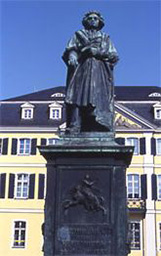
(1845)
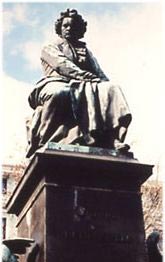
(1880)
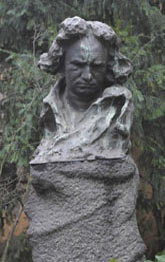
(1905)
1800 – 1830
Beginning and precursors
Any architectural or plastic monument displayed in public to honour an outstanding person can serve as a
monument.
Therefore, the Beethoven bust which Franz Klein produced in 1812 can be seen as a monument itself because
Beethoven's friend, Andreas Streicher, ordered this bust and intended to display it in a hall of his piano
manufacture along with other portraits of admired musicians. The room served as a concert hall, so the public
had access to the bust. Although the sculpture is quite modest and its main function is just to portray the
composer, it can already be regarded as the first Beethoven monument.
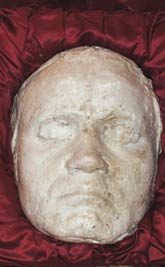
Old cast of the life mask Franz Klein made in 1812
(Beethoven-Haus Bonn, Collection H. C. Bodmer, BBi 4/21)
Photograph by H.-J. Schreck, 2002
To create a particularly realistic Beethoven bust, Franz Klein first made a mask of Beethoven's
face. Soon a few casts of the original mask were done, one of which was owned by poet Johann
Wolfgang von Goethe (now at the Goethe National Museum in Weimar). The cast shown here from the
collection of the Beethoven-Haus probably dates back to the first half of the 19th century.
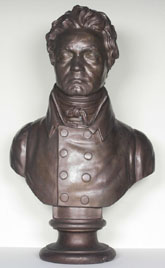
Bronzed cast of Franz Klein's original (Beethoven-Haus Bonn, P 2) Photograph by H.-J. Schreck, 2002
The aspect of veneration becomes much more visible when taking a look at Beethoven's tomb which some friends of
the composer had put up in the Währing cemetery.
The tomb resembles a group of tombs erected at the end of the 18th and early 19th century for which monumental
architectural elements were used to honour the deceased in an elevated way and enhance their importance.
Obelisks were especially popular for these middle class tombs.
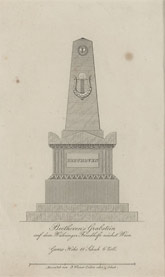
Unmarked steel engraving, 1829
(Beethoven-Haus Bonn, B 224)
After Beethoven's funeral his friends engaged in various activities to raise money for a tomb.
In the winter of 1827/1828 the tomb was ordered and finished no later than the first anniversary
of the day of Beethoven's death.
Franz Schubert's brother Ferdinand supposedly drafted the tombstone in the shape of an obelisk.
At least Ferdinand Schubert claims this in the notes for his autobiography. Even though no draft
design or drawing has been preserved, it may well be that Ferdinand Schubert, a gifted draughtsman
who worked as a teacher and choir director, drafted the monument. According to himself, he
frequently did drafts for stonemasons and designed inscriptions on tombstones.
Soon, these memorials lost their original purpose and tombs became middle class monuments which could be put up almost anywhere. An early example of such a genuine monument for a member of the middle classes is the obelisk erected for Johann Georg Büsch, a grammar school teacher from Hamburg. The similarity of such monuments to Beethoven's tomb gives evidence that people in Vienna followed these ideas and that Beethoven's tombstone marks the border between evocative memorial and monument.
1830 – 1845
The first Beethoven monument
Shortly after the composer's death, the cities of Bonn and Vienna felt the desire to put up a monument for
Beethoven. As it was rather unusual to erect a monument in honour of an artist who had just died, the memorial
should be fairly modern.
As a result, Vienna artist Friedrich von Amerling (1803–1887) and sculptor Ernst Julius Hähnel (1811–1891) from
Dresden chose to depict Beethoven in contemporary clothing in their drafts. To express the composer's creative
achievements, both artists portrayed Beethoven while composing and holding a quill in his right hand.
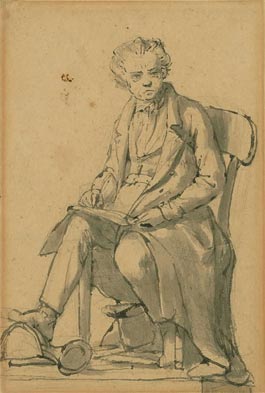
Washed pen drawing, mid-19th century
(Beethoven-Haus Bonn, NE 209)
Friedrich von Amerling made himself a name as portrait and history painter. Between 1830 and
1850 both members of the Austrian aristocracy and the middle classes appreciated his works. His
Beethoven depiction probably dates back to this time. The drawing excels in its particularly
plain style. The composer seems to just have taken a seat on his chair to write down a few
notes. His hat is under the chair, his foot rests on what looks like the case of an instrument.
The whole drawing gives a very spontaneous and lively impression as if capturing a random
moment taken from Beethoven's everyday life. In this way, Amerling's drawing meets the notion of
art of the Vienna Biedermeier Style and clearly differs from the drafts of other artists of the
mid-19th century.
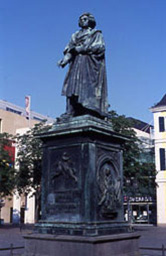
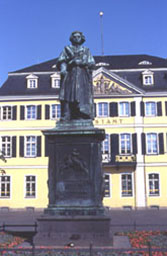
While it would take another 40 years until a Beethoven monument was finally erected in Vienna, the city of Bonn had a monument put up already in 1845. The ceremonial unveiling of the memorial was preceded by a long and arduous process of creation characterised by many disputes among the members of the monument committee. The involved musicians, historians and artists had fairly different opinions about what a monument for Beethoven should look like.
Photograph by S. Bettermann, 2003
Photograph by S. Bettermann, 2003
Photograph by S. Bettermann, 2003
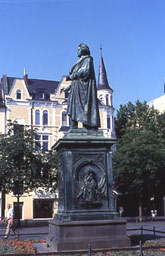
After many tries, Julius Hähnel was finally able to convince the Bonn committee in favour of his concept which included a Beethoven statue on a high pedestal adorned with allegorical reliefs. After Franz Liszt eased the project's financial problems through a generous contribution, the monument could finally be completed. Its unveiling was celebrated with a several-day-long music festival which founded the tradition of the still existing Beethoven festivals in Bonn.
1845
The Beethoven monument on the Münsterplatz in Bonn
When a competition for designing a Beethoven monument was held in Bonn, a number of more or less renowned German sculptors applied for this reputable project. In the end, the draft by Ernst Julius Hähnel, a successful sculptor from Dresden and Munich, was chosen. His concept was regarded as modern and still elevated enough.
Photograph by S. Bettermann, 2003
Photograph by S. Bettermann, 2003
Already in 1832 a Beethoven monument was to be erected in Bonn. When this project was almost
given up at the end of the 1830s due to financial and organisational difficulties, Franz Liszt
apparently learned through newspaper articles about the problems in Bonn. His personal interest
in Beethoven's music was enough reason for him to provide the necessary financial means. With
the support of Liszt's generous contribution, the amount needed for the monument was collected
in August 1840 and a public design contest was held regarding the monument. Seven German
sculptors submitted their drafts: Ernst Julius Hähnel (1811–1891), Gustav Hermann Bläser
(1813–1874), Johann Friedrich Drake (1805–1882), Hermann Knaur (1811–1872), Hermann Rudolf
Heidel (1810–1865), Eduard Schmitz von der Launitz (1797–1869) and Emil Cauer the Elder
(1800–1867). After Hähnel's draft was chosen, Jakob Daniel Burgschmiet (1796–1858) cast the
monument in Nuremberg. On 12 August 1845, the monument was unveiled at the Münsterplatz in Bonn
where it can still be seen.
Photograph by S. Bettermann, 2003
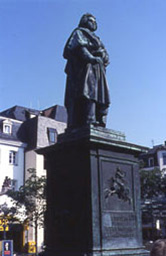
Hähnel portrayed Beethoven in the clothing typical for German and Austrian middle classes during the first half
of the 19th century: Shirt, neckerchief, long-sleeved jacket and long trousers. However, the artist added a
large coat to give the composer a certain superior impression.
Beethoven's pose – his legs are slightly apart and he holds a quill in his raised right hand – should
express his musical inspiration as well as the trendsetting aspect of his art.
Steel engraving, mid-19th century from: Hähnel, E. J./Langer, R. and T.: Ludwig van Beethoven's Denkmal zu Bonn, errichtet im Jahre 1845, erfunden und ausgeführt von Ernst Julius Hähnel, Bildhauer zu Dresden, gestochen von Robert Langer. n.p., n.d. (Beethoven-Haus Bonn, B 228 – 231)
Steel engraving, mid-19th century
from: Hähnel, E. J./Langer, R. and T.: Ludwig van Beethoven's Denkmal zu Bonn, errichtet im Jahre
1845, erfunden und ausgeführt von Ernst Julius Hähnel, Bildhauer zu Dresden, gestochen von
Robert Langer. n.p., n.d.
(Beethoven-Haus Bonn, B 228 – 231)
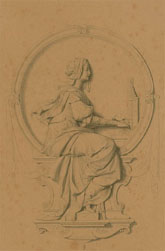
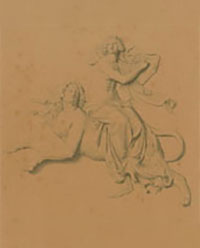
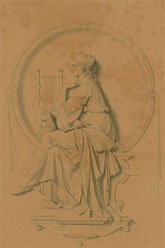
The four reliefs on the pedestal of the Bonn Beethoven monument show allegorical depictions of
music. The front side displays "The Phantasy" (accompanied by lyre and laurel wreath, riding on
a sphinx). The back features a woman's figure with kithara, "The Symphony". Putti playing
around her represent the different moods of a symphony. The monument's side facing the Bonn
Münster church shows "Spiritual Music" in a mediaeval gown at the organ. The other side features
"Dramatic Music" wearing an antique dress with a belt and playing the kithara. Two antique
theatre masks round out the depiction.
Steel engraving, mid-19th century
from: Hähnel, E. J./Langer, R. and T.: Ludwig van Beethoven's Denkmal zu Bonn, errichtet im Jahre
1845, erfunden und ausgeführt von Ernst Julius Hähnel, Bildhauer zu Dresden, gestochen von
Robert Langer. n.p., n.d.
(Beethoven-Haus Bonn, B 228 – 231)
Whereas Hähnel's Beethoven statue was met with criticism – people considered the statue as either too elevated or
too plain – the reliefs which Hähnel created for the high pedestal found the public's approval.
They feature allegorical depictions of the different types of music composed by Beethoven.
1845 – 1900
Further development of the Bonn type of monument
When designing the Beethoven monument for Bonn, Ernst Julius Hähnel used a monument type that was quite popular
for the honouring of middle class artists, scholars and scientists in the 19th century. The depicted person
usually stood with their legs slightly apart on a more or less square pedestal which was decorated with
inscriptions and reliefs. In most cases they wore contemporary clothing as well as a large coat to enlarge them
optically and render them more monumental.
Other examples of this type of monument include the monument for Jean Paul in Bayreuth (1841), the Goethe
monument in Frankfurt (1844) and the Herder monument in Weimar (1850).
Photograph by S. Bettermann, 2003
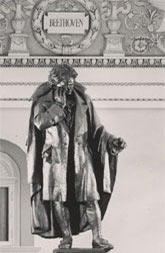
Anonymous photograph, around 1985 (Beethoven-Haus Bonn, B 1300)
Theodore Baur was born in Baden-Württemberg in 1835 and received an education as a sculptor and
decorator. Around 1850, he emigrated to North America where he participated in various public
projects such as the decoration of the Parliament Building in Ottawa, Ontario, or the Library of
Congress in Washington D.C. In the 1890s Baur lived in New York where he mainly decorated
private villas and became a member of the Fellowcraft Club. He returned to Germany in 1902, then
his trace disappears. His death date is unknown.
This way of depiction was popular all over Europe and continued well through the first half of the 20th century. German-American sculptor Theodore Baur (1835-approx. 1902) reverted to it when creating the Beethoven statue for the Library of Congress in Washington D.C.
1845 – 1910
The time of the great Beethoven monuments
The tradition of plain monuments showing a standing Beethoven on a more or less high pedestal continued well
through the second half of the 19th century. At the same time, quite a different and much more monumental style
developed where the composer usually sat in an armchair or on a throne.
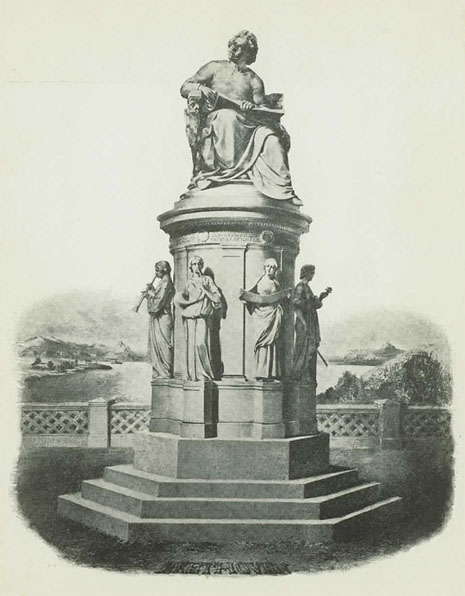
Reproduction of an anonymous engraving of a drawing by Adolph von Menzel with the depiction of
the draft by Drake, 1903/1904
(Beethoven-Haus Bonn, B 238)
Johann Friedrich Drake worked as an assistant of Christian Daniel Rauch (1777–1857) in Berlin. A
few years after Beethoven's death, he made various sculptures of the composer. The statues were
shown in public for the first time at the Berlin Academy exhibition in 1836.
Drake's models depict Beethoven either standing or walking and in contemporary clothing. The
sculptor changed this concept, however, when he partook in the contest for the Bonn Beethoven
monument in 1840 for which he submitted a monument draft with a sitting Beethoven. Even though
Drake's models were lost, his ideas were passed on through a lithograph Adolph von Menzel
(1815–1905) made using a drawing by Drake.
Drake was one of the first sculptors to design a high pedestal with allegorical figures where
Beethoven was to be sitting on a type of throne. The composer held a score on his lap, his eyes
ponderingly turned upwards. His clothes were to be idealised and should not resemble the
contemporary clothing of the 19th century. This draft is especially interesting as it mirrors
the tendency to elevate Beethoven by means of allegorical elements. In this regard, Drake's
concept surpasses middle-class statues and announces the richly adorned monuments of the
Wilhelmine era.
As one of the first artists, sculptor Friedrich Drake from Berlin (1805–1882) designed such a monument. Drake
probably began developing his ideas shortly after Beethoven's death in the 1830s. When the competition for the
Bonn Beethoven monument was held, he submitted a draft which is characterised particularly by a lavishly
decorated pedestal and the fact that Beethoven is shown in a sitting position.
Although Drake's draft was regarded as too heroic and therefore not chosen by the monument committee, his basic
concepts should lay the path for the further development of the Beethoven monuments of the late 19th
century.
1850 – 1910
Beethoven becomes an "Olympian figure"
In portraits and monuments, outstanding musical achievements of a person were traditionally expressed by adding a
lyre. This instrument, originally reserved for the god Apollo and the muses Erato and Terpsichore, can already be found
in 18th century depictions of musicians and composers.
On the one hand, this motif should refer to the musical context. On the other hand, a concrete relation to the
Olympian gods and muses should be established. Simultaneously, artists aimed at expressing music's divine source
of inspiration.
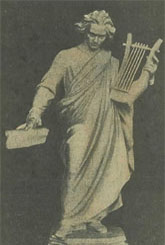
Reproduction of an old photograph of Bläser's draft, around 1920
(Beethoven-Haus Bonn, photo documentation Stephan Ley, Volume VIII, No. 78)
Sculptor Gustav Hermann Bläser who worked in Berlin focused particularly early on the idea of
drafting a monument for Beethoven. In 1836, only nine years after Beethoven's death, he created
the first model. Two years later Bläser displayed his Beethoven statues in public. When the
contest for the Beethoven monument in Bonn was held, Bläser submitted a daguerreotype and a
model.
Only one old depiction of the Beethoven statue gives evidence of Bläser's draft. Originally, the
statue was to stand on a pedestal decorated with allegories of religious and martial passion,
mourning and joy. A contemporary of Bläser's wrote that the draft showed Beethoven as master
over human feelings through his powerful music.
Jurors and the public liked the idea to represent feelings as allegories on the pedestal of a
Beethoven monument. Bläser's Beethoven statue was rejected, however, as the composer was not
shown in contemporary clothing but resembled an antique Orpheus or Apollo statue. In 1840 such a
concept did not meet the current notion of a modern monument for a musician who had died
recently. Only in the second half of the 19th century did such ideas become popular. From then
on Beethoven depictions displayed the composer accompanied by attributes of antique gods.

On a painting by Willibrord Joseph Mähler (1778–1860) the 34-year-old Ludwig van Beethoven already holds a lyre in his hand. In the monuments that were to be put up for Beethoven, the composer was soon equated with Apollo. In drafts from 1845, the composer is portrayed in the large coat so typical for ancient gods and holding a lyre and sometimes even Apollo's laurel wreath. The model shown here, created by Gustav Bläser (1813–1874) for the Bonn Beethoven monument, is a typical example of this idea.
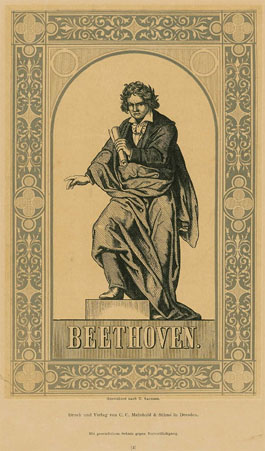
Whereas this type of Beethoven depiction was met with criticism and deemed too heroic in the first half of the
19th century, the general taste later changed drastically. Now the theoretical link between Beethoven and the
god became more and more popular until a complete heroisation of Beethoven was reached at the end of the 19th
century.
Emil Eugen Sachse's (1828–1887) work clearly expresses the transition from the middle class Beethoven monument
from around 1850 to the heroic interpretation that came up in the second half of the century. Beethoven is
still portrayed in a standing position and wears the clothes typical for 1825. However, his coat is far more
voluminous than in older drafts and resembles the robes worn by the ancient gods. The laurel wreath he wears
is another sign of this relation.
1878 – 1880
Caspar Zumbusch's Beethoven monument – I
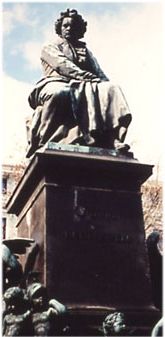
The most famous Beethoven monument from the second half of the 19th century is without doubt the one created by Caspar Clemens Zumbusch (1830–1915) in Vienna. The tendency to depict Beethoven as a hero and express the meaning of his music by scores of allegorical figures is even stronger than in Friedrich Drake's draft.
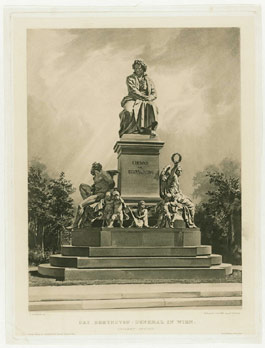
Heliogravure by the Institute for Military Geography, 1885
(Beethoven-Haus Bonn, B 234)
In his speech on the occasion of the unveiling of the Beethoven monument by Caspar Zumbusch at
the festival room of the Academic School in Vienna on 1 May 1880, Dr. Michael Walz basically
said the following:
"... not only to pay regard to and study the monuments of art do we wish to encourage you today ...
Every little piece of ground, every stone has its own history but you will have to learn its
history and language. Learn to observe and see what beauty is around, what humankind has
achieved and created. Don't walk the earth being unaware of its past. The ground is the
battlefield and graveyard of your ancestors. Don't walk the earth deprived of emotion and
wonder. Called 'cosmos' by the elders, it still remains as sound and beautiful as before. We too
are blessed with the sun of Homer. If you are blind to this wonderful spring with its violets,
to this vast starlit sky with its tongues of flames, then we call
on you in vain: 'Siste viator!' (Rest wanderer) ..."
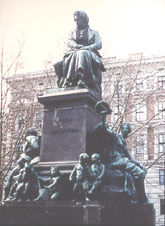
The composer rests enthroned far away from the beholder on whom he looks down. The front and rear side of the monument feature putti at the composer's feet, representing his symphonies or his music in general. Prometheus and goddess Fama are on the sides of the monument. The entire construction is supported by a three-step base.
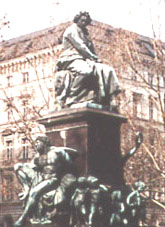
Photograph by S. Bettermann, 2001
The large male sculpture on the pedestal of Caspar Zumbusch's Beethoven monument represents the
antique titan Prometheus. According to Greek mythology, Prometheus stole fire from the gods and
gave it to humans on earth. He was punished with eternal pain as he was chained to a rock. Every
day Zeus sent an eagle to eat from the titan's liver which then grew back. Only after centuries
was Heracles able to free Prometheus. Equating Beethoven with Prometheus was quite popular in
the 19th century as Beethoven's personal tragedy of deafness and Prometheus's torture were
compared. Both titans had to suffer pain for the sake of humanity. Such ideas were developed
further in the second half of the 19th century. A newspaper article from 1877 describes the
Prometheus from Zumbusch's monument as "the embodiment of a never resting and never satisfied
longing: the own self of the human soul, struggling like a titan."
Photograph by S. Bettermann, 2001
The opposite side of the monument's pedestal features a winged goddess holding a laurel wreath in her hands. This allegorical sculpture might represent the goddess of victory Nike or Victoria, expressing the triumph of Beethoven's spirit, mind and art over his personal tragedy. According to an article published in the newspaper "Neues Wiener Tagblatt" on 24 September 1877, the goddess of victory gives Beethoven the wreath of glory after his struggle.
1878 – 1880
Caspar Zumbusch's Beethoven monument – II
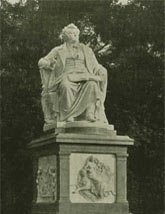
The Beethoven monument by Caspar Zumbusch was not the first monument for a Vienna musician. In 1862, the Vienna Male Choral Society took the initiative to have a statue erected for Franz Schubert. It was designed by artists Theophilus Edvard von Hansen (1813–1891) and Carl Kundmann (1838–1919) and unveiled in 1872.
Photograph by S. Bettermann, 2001
Steeliness, love of freedom and solitude are the most influential notions for the depictions of
Beethoven throughout Late Romanticism. The Beethoven monument Caspar Zumbusch designed for
Vienna in 1878 and unveiled two years later may serve as the best example of such a view of
Beethoven. The sculpture of the sitting Beethoven was deliberately designed like the statue
of Moses by Michelangelo in the San Pietro in Vincoli church in Rome. Thus, a clear connection
was established between two particularly admired titans of the European intellectual world of
the 19th century.
In the 1870s Vienna felt a need to finally set up a monument for Ludwig van Beethoven and held a competition. Well-known artists – particularly Franz Liszt and Johannes Brahms – supported the project with generous financial contributions so that the monument could be presented to the public on 1 May 1880.

Heliogravure by the Institute for Military Geography, 1885 (Beethoven-Haus Bonn, B 234)
Reproduction of a photograph of the monument marked with the monogram "A.G.", 1913
(Beethoven-Haus Bonn, B 1337)
The new and special features of Caspar Zumbusch's monument become particularly clear when comparing it to the
slightly older Schubert monument by Carl Kundmann. Kundmann also presented the composer in a sitting position
on a high pedestal and wrapped in a large coat. However, his monument is less pompous and conveys a more private
atmosphere. This is mainly due to the pedestal's design which, for the Schubert monument, was decorated with
reliefs, whereas the pedestal of the Beethoven monument features vivid sculptures.
Therefore, Caspar Zumbusch's monument represents the strong self-confidence of the German and Austrian upper
middle classes which regarded themselves as the main supporters of German art during the second half of the 19th
century. In accordance with this conviction, the monument should not only honour an important person but also
adorn the city, as a newspaper article from 1877 says.
Around 1900
From Apollo to Jupiter
The admiration for Beethoven as the epitome of a creative artist hit its peak at the end of the 19th and during
the first third of the 20th century. The heroisation of the composer in fine arts was not restricted to Germany
and Austria but was also expressed in works by French artists and in various monuments erected on the American
continent.
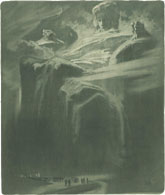
From now on Beethoven was not depicted as a contemporary musician or inspired composer but compared to the
heroically struggling titan Prometheus or even Jupiter, the highest of all gods.
Etching, around 1905 (Beethoven-Haus Bonn, B 865)
To express this special admiration for Beethoven, many artists such as Franz von Stuck (1863–1938) or Joseph Adolf Lang (1873–before 1928) portrayed the composer on a very high throne. By using plain and blocklike forms, they tried to give their works a particularly monumental impression to show the distance between the titan "Beethoven" and the ordinary human being.
Anonymous heliogravure, 1902/1903
(Beethoven-Haus Bonn, B 239)
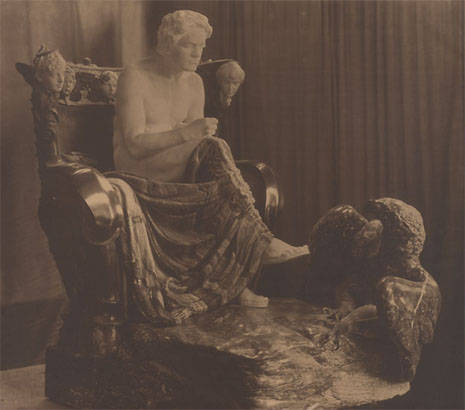
Max Klinger's Beethoven monument is probably the best example of such late romantic ideas in fine arts. Klinger (1857–1920) strongly admired Beethoven. He believed that music was clearly superior to sculpture as it depended less on the material world and was therefore closer to deity than fine arts. Beethoven, who in Klinger's eyes was the greatest composer, was therefore not just an inspired and creative man. In the artist's opinion, he had almost become a god and the epitome of an artist.
Max Klinger's Beethoven monument
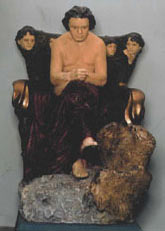
Already in the 1880s Max Klinger, then living in Paris as a student, focused on the project of creating a monument in honour of Ludwig van Beethoven. As he once said, he had the first ideas for a sculpture when playing the piano. Thus, the first version of the later monument was born. Klinger then realised his idea in gypsum and coloured it vividly.
(Beethoven-Haus Bonn, P 18/a)
Photograph by H.-J. Schreck, 2002
The painted and gilded gypsum model for Klinger's Beethoven sculpture closely resembles the
final version of the monument from 1902.
Especially the reliefs that decorate the throne contain various motifs from the antique but
also Jewish and Christian world. In combination these elements are not easy to interpret. The
depiction's two main topics, however, are very clear: Eternal suffering and hope of deliverance.
The sides of the throne show mankind's fall and the pain of Tantalus in the underworld. The back
side features newly born Aphrodite in the foreground, rising from the foam of the sea. A figure
rushing forward – an apostle or prophet – indicates the goddess. In the background, the
crucifixion of Christ can be seen. As distinct from the final marble version the front of the
throne's back is decorated with reliefs in the model. Antique hero Ixion who was banished to the
Underworld for his misdeeds as well as Prometheus are shown, according to Greek mythology the
creator of humankind, who brought fire to the mortals and was then chained to a rock and tortured
by the eagle of Zeus as punishment.
In the second half of the 19th century this motif was often used in combination with Beethoven
(among others by Caspar Zumbusch for the 1880 Beethoven monument in Vienna). For the Romanticists
of that time, Beethoven had become the epitome of an artist of genius, in contact with the
supernatural world of deity and therefore damned to suffer.
Colour print of a photograph by photo studio Rommler, around 1904 (Beethoven-Haus Bonn, B
455/a)
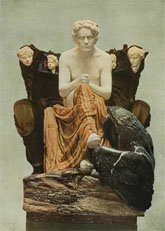
Max Klinger's Beethoven monument is the result of the sculptor's personal admiration for Ludwig
van Beethoven. The monument shows a number of various motifs to celebrate Beethoven as a genius
and elevate him to the rank of the highest Olympian gods. Beethoven's energetic body posture, his
taut facial features and his clenched fist express a strong will. Klinger not only wanted to
portray the painful act of creation and the struggle for a higher truth but also the overcoming
of all physical weakness and suffering through the power of the mind.
For the Late Romanticists, Beethoven had become the epitome of a creative artist of genius, in
contact with the supernatural world and therefore damned to suffer but able to overcome this
suffering. Thus, Klinger's sculpture, originally created out of very personal motives,
emphasises the myth of the artist and his heroic fate which so strongly influenced the notion of
the 19th century.
During the decades before 1900, Max Klinger used this model to design a large-format sculpture. He unveiled it
for the first time in public at the exhibition of the Vienna Secession in 1902.
Also Max Klinger depicted Beethoven as a bare-chested Olympian deity. Thereby, the sculptor alluded to the
ancient way of depicting gods. The large coat that is wrapped around the composer's lower body and the sandals
he wears were designed according to traditions of the ancient world. Beethoven sits on a richly decorated
throne. At his feet rests an eagle, Jupiter's heraldic animal. Beethoven's hands are clenched into fists, his facial
expression seems concentrated and energetic.
Beethoven's "high rank" in Klinger's sculpture is additionally supported by allegorical scenes on the throne's
exterior where the composer is also related to redemption motifs taken from Christianity.

Anonymous photograph of an old original, around 1985
(Beethoven-Haus Bonn)
Just like on the day of its unveiling Max Klinger's Beethoven sculpture still divides the public
as can be seen from the comments about the model in Bonn. On the other hand, art historical
research has been trying for a few years to put Klinger's works in their historical context and
judge them accordingly.
Georg Bussmann might have given the best description of Klinger's ideas for the design of the
sculpture when he said that it was the extreme and superlative impression of the monument that
fascinated the beholder, an impression that wanted to go beyond all common ideas of a monument,
a monument to astonish and leave the onlookers breathless and speechless. And according to
Bussmann, it certainly does so, no matter whether we like it or not. (G. Bussmann in: D. Gleisberg
(editor): Max Klinger, 1857–1920. Leipzig 1992, p. 38)
Max Klinger presented his Beethoven sculpture for the first time in public in Vienna in 1902. The room at the
Secession building, where the work was put up for display, features a frieze of figures by Gustav Klimt (1862–1918).
The unusual sculpture caused a public indignation because it was regarded as inadequate and consequently
met with derision.
Only after quite some years could Klinger sell the sculpture to the city of Leipzig. From then on, his monument
was seen as the ideal of a heroic Beethoven monument, showing the composer as an epitome of the human mind which
can become godlike through achievement.
1900 – 1910
Beethoven monuments of the Reform Movements in the early 20th century
Max Klinger was not the only artist of the early 20th century to express his admiration for Beethoven. During
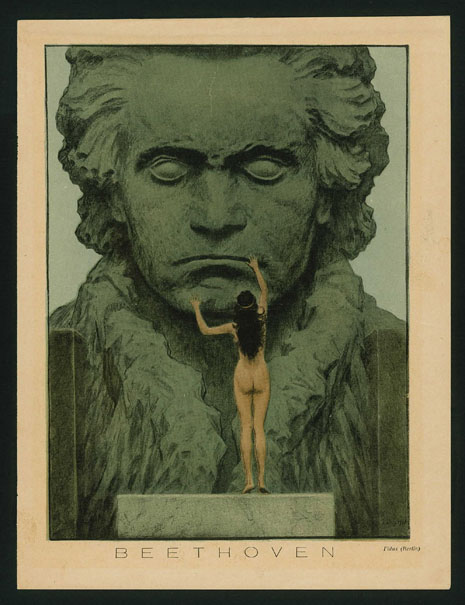
this time a whole range of works was created. Particularly interesting is the project by Fidus, a reform artist,
which is based on a monumental concept.
Whatever activities he engaged in, Fidus always aimed at reforming the modern world's entire worldview and view
of life.
Consequently, he wanted to create alternatives for the power of established occidental churches and
Christianity. From this approach he developed several drafts and concepts for temples to glorify outstanding
achievements and ideas of the occidental culture.
Reproduction of a watercolour painting, 1903
(Beethoven-Haus Bonn, B 296)
His draft for a "Beethoven temple" is to be seen in this context: A rotunda with a cupola and a centre with an
oversized Beethoven portrait.
The first draft for this sculpture dates from 1900 and includes a half-length portrait of the composer. A naked
female figure – probably the human soul – stands in front of Beethoven.
Just like many other projects, Fidus never realised his draft for a Beethoven temple.
1900 – 1910
Searching for new forms
While Max Klinger and Fidus developed their romantic ideas of Beethoven as a "superman", other artists created their own concepts for a Beethoven monument. Some of these drafts and models strictly followed the traditional types and forms of the 19th century. Other artists tried to break new ground.
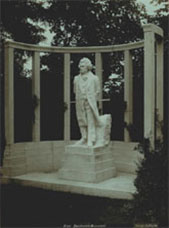
Photograph by August Stauda, around 1912
(Beethoven-Haus Bonn, B 242)
The sculpture Robert Weigl created shortly before his death is probably the most extreme example
of a realistic depiction of the composer among all Beethoven monuments of the 19th and 20th
century. The composer is shown on a walk, his coat and tie flapping in the wind and his curls
tousled. The details of the sculpture and clothing were carried out meticulously: The buttons on
jacket and waistcoat, the fabric of the trousers pressed tightly to Beethoven's legs by the
wind. All this results in an unusually vivid impression, which is only reduced by the fact that
the sculpture is carried out in white colour.
With his monument, Weigl focused on a topic that had been depicted and interpreted since the
beginnings of the romantic Beethoven admiration: Beethoven in nature. First, idyllic scenes
were popular such as Beethoven by a brook composing the Pastoral Symphony. Later, the composer
was often depicted in a storm to portray his character and the character of his music.
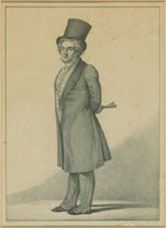
Lithograph, 1841
(Beethoven-Haus Bonn, B 1937)
Prague painter and lithographer Martin Tejcek, who lived in Vienna from 1821 onwards, created a
Beethoven depiction quite popular throughout the 19th century. The composer is shown on a walk,
wearing elegant clothing. Beethoven is depicted as a whole figure, turned slightly to the left.
He wears a top hat just like Gerhard von Breuning described in his memoirs "Aus dem
Schwarzspanierhause" (1874) and has his arms behind his back, a piece of paper, probably a piece of
sheet music, in his hand.
The composer's contemplative appearance meets the description painter August von Kloeber noted
down after meeting Beethoven in Mödling near Vienna. Von Kloeber met Beethoven several times on
his walks and said the composer would often pause on a walk, a piece of sheet music and a pencil
stub in his hand, listening and looking up and down and would then write notes on the paper.
Of particular interest is the Beethoven monument erected by Robert Weigl (1851/52 – 1902) in
Vienna-Heiligenstadt. Weigl's approach was clearly different from the concepts of the late romantics and conforms more
closely to the naturalistic idea of the mid 19th century.
Weigl used a lithograph by Martin Tejcek (1780 – 1847) that shows Beethoven on a walk as model for his Beethoven
figure. The artist created his sculpture closely following the depicted Beethoven and thus achieved a very
realistic effect. His monument should give the beholder the impression as if he had just met Beethoven on a
walk. Here, Beethoven is shown in an entirely human way.
Only a few years after this sculpture was put up, such a concept was regarded as not monumental enough. As a
consequence, a peripteral enclosure was built around the statue to separate it from the beholder's world.
Beethoven depictions influenced by Auguste Rodin
Antoine Bourdelle – I
In the years around 1900 the admiration for Beethoven reached a special height not only in Germany and Austria but also in France where men of letters and artists focused on Beethoven and his art. Two artists living in Paris were especially important for the development of a novel and modern type of monument: Antoine Bourdelle (1861–1929) and Naoum Aronson (1873–1943). Both were taught by and worked for Auguste Rodin (1840–1917), without doubt the most important European sculptor of the late 19th century. In their style both artists were strongly influenced by Rodin's expressive works.
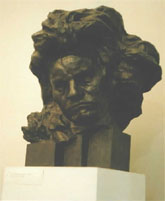
Photograph by F. Gramlich, 1987
(Beethoven-Haus Bonn, B 2013)
Emile-Antoine Bourdelle focused on Ludwig van Beethoven throughout his whole life. As early as
1889 he created the first Beethoven busts. Until his death in 1929 Bourdelle repeatedly dealt
with the great composer's personality and art. The bust named "Beethoven au foulard" dates from
the first phase of the sculptor's dealing with Beethoven as a subject. At that time, Bourdelle
still imitated his model's actual features. This sculpture strongly resembles the Beethoven
portraits that were drawn during the composer's lifetime.
Throughout his life, Emile Antoine Bourdelle dealt with Ludwig van Beethoven. He created the first Beethoven busts in 1889. Until his death in 1929, Bourdelle repeatedly focused on the great composer's personality and art, creating many drawings, designs, models and sculptures depicting Beethoven. Even today, more than 20 different portraits of the composer by Bourdelle exist.
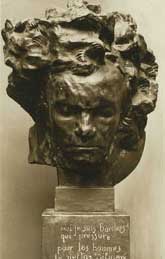
Photograph by photo studio H. N., around 1929
(Beethoven-Haus Bonn, B 417)
One of Emile-Antoine Bourdelle's most famous Beethoven busts dates from the time when Bourdelle
worked as an assistant for French sculptor Auguste Rodin. Bourdelle made various versions of
this sculpture. Some are attached to a pedestal with the following inscription on the front
side: "Moi, je suis Bacchus, qui pressure pour les hommes le nectaire delicieux ..." (I am
Bacchus who makes the delicious nectar for humans.) This sentence – called "parole", i.e. motto, of
Beethoven by Bourdelle – clearly expresses the sculptor's view of Beethoven and his music. The
composer became the epitome of a creative genius, close to the rank of a god.
While this interpretation is pretty much identical to the one of the German Late Romanticists
like Max Klinger, Bourdelle's way of carrying out this view is entirely different from the way
German artists followed. Bourdelle was not interested in a realistic depiction of Beethoven and
preferred Rodin's modern free language of forms and shapes. He aimed at expressing Beethoven's
inward turmoil and struggle as well as his personal tragedy.
Although Bourdelle's admiration for Beethoven was as high as the admiration shown by German late romantics, his style is entirely different from the way German artists portrayed the composer. Around 1900 at the latest Bourdelle was not interested in creating Beethoven's realistic looks but preferred a monumental depiction of the composer, expressing pathos, tragedy and heroic passion. To achieve this effect, Bourdelle used free forms full of vigorous movement. In their expressivity and passions, these forms are evocative of works by Rodin.
Beethoven depictions influenced by Auguste Rodin
Antoine Bourdelle – II
Bourdelle's fascination for Beethoven continued until the sculptor died. During the last five years of his life, Bourdelle produced no less than six busts and sculptures showing the composer.
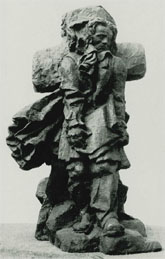
Anonymous photograph, 1986
(Beethoven-Haus Bonn, B 1972)
Although Emile-Antoine Bourdelle also created portraits of other musicians (for example a bust
of Frédéric Chopin), it was Ludwig van Beethoven whom Bourdelle considered the epitome of an
artist struggling for greatness. Gradually, the sculptor identified himself with Beethoven in an
artistic way. According to Bourdelle, music and sculpture are principally the same. Just like a
musician composes with sounds, a sculptor composes with masses and volumes.
Bourdelle's fascination for Beethoven continued until the sculptor died. During the last five
years of his life, Bourdelle produced no less than six Beethoven busts. The last work is this
sculpture named "La Pathétique" or "Beethoven à la croix". It shows how strongly Beethoven
epitomised the suffering and struggling genius for the artists of the late 19th and early 20th
century. In this way, Bourdelle's works also express an intimate avowal of his own self and his
self-conception as a creatively working and struggling mind.
This figure named "La Pathétique" or "Beethoven à la croix" is Bourdelle's last work. It shows how strongly Beethoven epitomised the suffering and struggling genius in the eyes of the late 19th and early 20th century artists. The symbol of the cross proves that the composer was not only identified with pagan deities but was also interpreted as the suffering redeemer in a Christian sense. In this way, Bourdelle's works also express an intimate avowal of his own self and his self-conception as a creatively working and struggling mind.
Beethoven depictions influenced by Auguste Rodin
Naoum Aronson's Beethoven monument in Bonn
The second student of Rodin who concentrated on designing a monument for Beethoven was the Latvian sculptor Naoum Aronson (1873–1943).
Photograph by J. Weidner, 2002
Naoum Aronson was born to Jewish parents in Kraslawa, a small town in Latvia close to the
Belarus border. At the age of 14 he already wished to work as an artist. He first took lessons
at the Art Academy in Vilnius, then at the drawing school of icon and genre painter Iwan
Petrowitsch Trutnjeff (1827–1912). Around 1891/1892 Aronson moved to Paris to study sculpture at
the reputable "École des Arts Décoratifs". Here, Aronson was first taught by Hector Lemaire
(1846–1933). Later, he also took lessons at Filippo Colarossi's Academy and with Auguste Rodin
(1840–1917). Especially during the first two decades of the 20th century Aronson was deeply
influenced by Rodin's strongly impressionistic style.
After a starting phase with economic difficulties Aronson managed to make himself a name on the
Parisian art market through some successful works. From then on he belonged to the
internationally renowned representatives of French impressionist and symbolist sculpture and had
many opportunities to display his works.
Despite Aronson's interest in the new concepts in communist Russia to which he returned once in
a while, Paris remained the centre of his life and work. Until the 1930s Aronson was highly
reputable. He taught at the École des Arts Décoratifs. In 1926 he presented his works in a large
single exhibition. During the occupation of France by the Nazis, the 65-year-old artist was
forced to leave the country due to his Jewish origins. With the help of a French woman, Aronson
fled to Portugal and later to the United States where he died on 30 September 1943 at the age
of 70.
In the summer of 1905 Naoum Aronson visited the concerts of the seventh Bonn Chamber Music Festival organised by the Beethoven-Haus. Under the impression of the performed music, the sculptor already began his first studies for a Beethoven bust during his visit.

Reproduction of a red chalk study, 1911
(Beethoven-Haus Bonn, B 411)

(Beethoven-Haus Bonn, P 46)
Photograph by H.-J. Schreck, 2002
After Aronson gave the model of his Beethoven bust to the Beethoven-Haus as a gift in the summer
of 1905, the city of Bonn decided to order a bronze version of the sculpture to be put up in the
garden of the Beethoven-Haus.
Regarding the design of the monument and pedestal, the management of the Beethoven-Haus
contacted Aronson again as the sculptor had just designed a fountain in Bad Godesberg and
therefore had experience in presenting monuments.
Aronson had various suggestions for the pedestal for his Beethoven bust. It seems that first an
elaborate pedestal was planned, however, a rather plain design was then preferred. Aronson sent
the gypsum model shown here to Bonn where the management accepted his draft except for the
inscription and carried the monument out in granite.

(Beethoven-Haus Bonn, P 15)
Photograph by H.-J. Schreck, 2002
Ludwig van Beethoven's portrait bust is one of the most successful works Naoum Aronson did. A
cast of the composer's life mask that was displayed at the Beethoven-Haus probably served as a
model for Beethoven's facial features whereas the composer's hair and implied clothing were
designed freely by Aronson.
In the summer of 1905 Aronson received a gold medal at the World Exhibition in Liège for the
monumental gypsum model he created at his Paris studio. The directors of the Beethoven-Haus
liked the model so much that they ordered a bronze version of the bust in August of the same
year and also asked Aronson to design a pedestal.
Shortly afterwards, Aronson produced a monumental gypsum model in Paris. The intensive effect of his Beethoven
portrait is particularly enhanced by the way Beethoven's head is tilted and the clouding of his eyes. The
composer does not face the beholder but averts his gaze and appears as an artist full of passionate ideas but
living in his own world – an opinion totally in line with the ideas of the early 20th century.
Aronson gave his model to the Beethoven-Haus which appreciated this modern depiction of the composer so much
that it asked Aronson in August 1905 to reproduce the bust in bronze. In the autumn of 1905, a granite pedestal
was made for the sculpture following Aronson's draft. On 17 December 1905 the monument was finally unveiled
in the garden of the Beethoven-Haus. There it can still be seen and admired by the museum's visitors.
1920 – 1939
Beethoven monuments between tradition and modernity
The general veneration of Beethoven reached a second peak between 1920 and 1930. On the one hand this was due to the fact that 1927 was the 100th anniversary of Beethoven's death day. On the other hand, this intensive focus on Beethoven in Germany was a result of the traumatic experience from the First World War. After the military defeat, Germany reverted to cultural achievements in order to obtain national self-confidence.
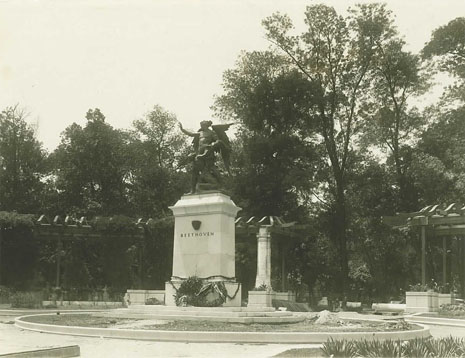
Photograph by H. Brehme, around 1925
(Beethoven-Haus Bonn, B 454)
Sculptor Theodor von Gosen was born in Augsburg and educated at the Munich Art Academy where he
joined the Movement for the Promotion and Reformation of Arts and Crafts. During this time Gosen
mainly designed small bronze sculptures and pieces of jewellery.
From the early 20th century on Gosen worked as a professor at the Art School in Breslau where he
was director of the studios for bronze casting and chasing. In these years, he focused on large
sculptures and created a number of monuments and sculptures for Breslau. Contemporary sources
praise his classy naturalism, understanding of materials and the brilliant technical execution.
The monuments and monument drafts from this time are characterised by their concepts and style being very
various. They share the intention of depicting Beethoven not so much as a person but instead show his music.
Thus, quite different approaches resulted where Beethoven's artistic achievement was the main subject, whereas
depicting the composer as a person was given less importance.
An example of such an approach is Theodor von Gosen's (1873–1943) Beethoven monument in Mexico City.
Allegorical elements, which in the 19th century were typically part of a monument's pedestal area, became the
most important part of the monument. A winged Genius is placed on a high pedestal. A figure – the suffering
human soul – kneels in front of him and pleads for redemption. Beethoven's mask, which is attached to the
pedestal, clearly suggests the message that redemption can be found in his music.
1926
A Beethoven monument in Berlin
When Berlin arranged a competition regarding a Beethoven monument in 1926, the search for new forms for such a
monument hit another peak. Many famous sculptors submitted drafts and models, among them Ernst Barlach (1870 –
1938) and Georg Kolbe (1877 – 1947). German press amply dealt with the subject and partially severe criticism
was voiced. As opinions among the competition committee members and the press were rather different and as the
entire project was quite controversial, the prize awarding never took place and the plans for a new Beethoven
monument were finally dropped completely.
Only two of the submitted drafts were later carried out as monuments: Georg Kolbe's and Peter Christian Breuer's
(1856 – 1930).
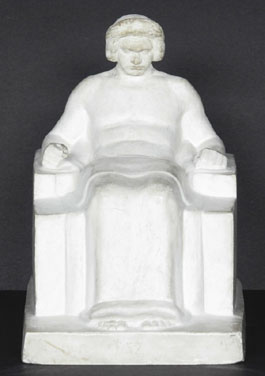
(Beethoven-Haus Bonn, P 31)
Photograph by H.-J. Schreck, 2002
The Beethoven monument by Cologne sculptor Peter Christian Breuer has a particularly long and
chequered history. Breuer, who had worked as a professor at the Berlin Art Academy since 1897,
probably dealt with designing a Beethoven monument around 1910. He supposedly made several
drafts, however, no large project was realised. Because sources are not consistent, it is
impossible to determine the model's exact date of creation.
When a public competition was announced for a Beethoven monument in Berlin in 1926, Breuer
submitted his proposals, among them his older drafts. In its effect Breuer's Beethoven sculpture
is strongly determined by the squareness of the figure and the flatness of the forms. Thus the
monument is a typical example of the sculptor's artistic development in the first quarter of the
20th century. Breuer gradually distanced himself from the naturalistic Neo-baroque style and
favoured a monumental effect for his works by reducing details and stylising individual forms.
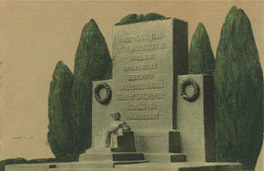
The Beethoven monument by Breuer, who came from Cologne, has a particularly long and chequered history. Apparently, Breuer had already dealt with designing a monument for Ludwig van Beethoven around 1910. However, the draft was not realised. When the Berlin competition took place, Breuer submitted a draft for which he reverted to his prior ideas.
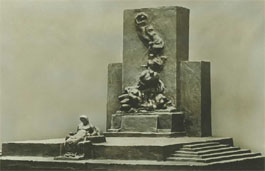
Anonymous photograph, around 1926 (Beethoven-Haus Bonn, photo documentation Stephan Ley, Volume VIII, No. 97)
Collage, around 1930
(Beethoven-Haus Bonn, B 1388)
Now, he designed a vast site composed of architectural elements and various figurative depictions. At its centre, the monument featured a seated larger-than-life Beethoven. After the Berlin monument project was given up, the city of Bonn took an interest in Breuer's draft. The sculptor then edited his concept. The originally planned site should now be smaller and less pompous and be integrated in a park scenery.
1926 – 1938
Peter Christian Breuer's Beethoven monument
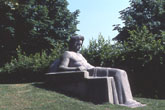
Beethoven sculpture at the Rheinaue in Bonn (1926–1938)
Photograph by S. Bettermann, 2003
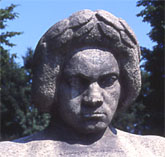
As distinct from the naturalistic monuments of the 19th century or Bourdelle's and Aronson's
expressive monuments, Peter Christian Breuer's Beethoven sculpture is marked by stylised, almost
summary forms. Only the composer's hands and his face are portrayed meticulously to express
Beethoven's inner tautness and concentration. The rest of his body is rather block-like so that
the whole sculpture resembles the sculptures of Ancient Egypt which Breuer and the group around him
focused on in Berlin during the first decade of the 20th century.
By reverting to these archaic forms, Breuer intended to express the permanence and continuance
of Beethoven's art. Granite as material for the monument should furthermore increase this
impression. It seems that a part of the broad public understood Breuer's concept in the 1920s as
his draft was repeatedly described as an "eternal monument" in the press around 1930.

Beethoven sculpture at the Rheinaue in Bonn (1926–1938)
Photograph by S. Bettermann, 2003
When Breuer presented his first models for a Beethoven monument in 1916, the public's reactions
were quite controversial. On the one hand, his sculpture was severely criticised because it was
compared to Max Klinger's sculpture and often regarded as a second rate copy although both
monuments are entirely different in their concept and style.
On the other hand Breuer's concept was effusively praised by art critics and Beethoven admirers.
This admiration culminated in the 1920s when supporters of Breuer's draft joined their efforts
and called on the public to make financial contributions for the monument. After the plans for
the monument in Berlin had been given up, the group focused on organising the installation of the
sculpture in Bonn. However, it would take a number of years until their efforts were met with
success. Because the supporters had first contacted the Reichsminister for Propaganda and later
Adolf Hitler directly, the project was given top priority. In the eyes of the public, Breuer's
"eternal monument" had now become a "national monument".
Eventually, only one element from Breuer's model was actually realised in a larger format. Fritz Diederich, a long-time assistant of Breuer's, created Beethoven's figure in granite. After Breuer's death, the sculpture was displayed in public in 1938 at the 'Alte Zoll' in Bonn. In 1949, it was removed and put up for display again in 1977 – this time at the 'Rheinaue' in Bonn.
Beethoven sculpture at the Rheinaue in Bonn (1926–1938)
Photograph by S. Bettermann, 2003
1950 – 2000
A time for experiments – I
Already during the first half of the 20th century, artists designing monuments for Ludwig van Beethoven were
looking for new concepts. As many of the previously accepted forms and subject matters were being questioned due
to the experiences of the Second World War, the search for new concepts even increased in the years after 1945.
Thus a number of new approaches were developed, quite different in their meaning and style. American sculptor
Eugen Ciuca (*1913), for example, chose purely abstract forms to express his veneration of Beethoven's music for
his monuments.
Photograph by S. Bettermann, 2003
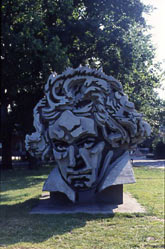
Sculptor Klaus Kammerichs from Düsseldorf went an entirely different way when focusing on Beethoven as a person. He created a large-format, three-dimensional version of the Beethoven portrait by painter Joseph Karl Stieler (1781–1858). Stieler's painting from 1820 is now one of the most popular and famous Beethoven depictions of the 19th century.
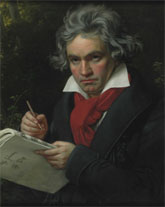
Oil painting, 1820
(Beethoven-Haus Bonn, B 2389)
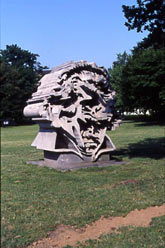
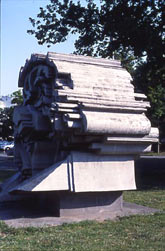
The monument erected by Klaus Kammerichs in front of the Beethoven Hall in Bonn in 1986 captures the whole basic difficulty a modern society experiences regarding the exposure to Beethoven as well as its opinion towards outstanding artists of the past. In his work, Kammerichs related to a portrait that influenced our idea of Beethoven's appearance like no other portrait. Therefore, the sculptor not only created a monument that looked familiar but also made it clear how strongly conventions and ideas from the past influence modern society in its view of Beethoven.
1950 – 2000
A time for experiments – II
For its first public presentation, the Beethoven monument by Klaus Kammerichs was not yet called "Beethon" as it is today but "Mythos Beethoven" (Beethoven Legend). The monument was created with the intention of expressing the difficulty that arises when dealing with Beethoven these days.
Photograph by S. Bettermann, 2003
Just like Klaus Kammerichs' sculpture consists of different layers, the present Beethoven view
comprises different forms of our reception of past epochs. The more we approach the magnified
image of the composer, the less we are able to recognise Beethoven.
As our view of the past is always influenced by modern science and research, Kammerichs' monument
clearly reveals the difficulty we have in understanding the art of the past. The search for
details and new approaches makes it more difficult to see and perceive the piece of art and its
creator. When looking at Kammerichs' monument, one can easily discover this fact for oneself.
Photograph by S. Bettermann, 2003
The history of the Beethoven monuments of the 19th and 20th century not only mirrors the development of an art
genre but is closely linked to the way Ludwig van Beethoven was revered during the various epochs. All
monument projects also express the general opinion the broad public had about Beethoven.
The fact that the first efforts to create a monument for the dead composer go back to only a couple of years
after Beethoven died, and that memorials and monuments are still erected, gives clear evidence that the
composer's charisma and the influence of his music still prevail until today. On the other hand, it shows how
strong the general need was and is to honour an outstanding composer with a public monument. We can expect with
great anticipation what monuments for Beethoven will look like in the third millennium.
Photograph by S. Bettermann, 2003
Literature
On the topic in general
F. J. Alai: Beethoven glorified in statues. London 2000.
I. Bodsch: 'Monument für Beethoven'. Die Künstlerstandbilder des bürgerlichen Zeitalters als Sinnstifter
nationaler Identität?
in: I. Bodsch (Hrsg.): Monument für Beethoven. Bonn 1995, S. 157–177.
R. Cadenbach: Mythos Beethoven. Laaber 1986.
H. Hallensleben: Das Bonner Beethoven-Denkmal als frühes "bürgerliches Standbild"
in: I. Bodsch (Hrsg.): Monument für Beethoven. Bonn 1995, S. 29–37.
J. Schmoll genannt Eisenwerth: Zur Geschichte des Beethovendenkmals
in: Saarbrücker Studien zur Musikwissenschaft. Bd. 1. Kassel 1966, S. 242–277.
On individual artists and monuments
S. Einholz: Peter Breuer (1856–1930). Ein Plastiker zwischen Tradition und Moderne.
Phil. Diss. Berlin 1984.
D. Gleisberg (Hrsg.): Max Klinger, 1857–1920. Leipzig 1992.
H. Guratzsch (Hrsg.): Max Klinger. Bestandskatalog der Bildwerke, Gemälde und Zeichnungen im Museum der
bildenden Künste Leipzig. Leipzig 1995.
I. Jianou / M. Dufet: Bourdelle. Paris 1984.
G. Kapner: Ringstraßendenkmäler. Zur Geschichte der Ringstraßendenkmäler. Dokumentation. Wiesbaden 1973.
E.-M. Klother: Emile Antoine Bourdelle: 'Ludwig van Beethoven (Grand Masque Tragique)', 1901
in: Kölner Museums-Bulletin. (2003) 4, S. 13–22.
H. Loos: Max Klinger und das Bild des Komponisten
in: Imago Musicae. 13 (1996), S. 165–188.
P. Naredi-Rainer: Granitstarker Klang. Max Klingers "Beethoven", die Musik Gustav Mahlers
und die Sprache der Materialien
in: P. Naredi-Rainer (Hrsg.): Imitatio. Berlin 2001, S. 218–227.
S. Schaal: Das Beethovendenkmal von Ernst Julius Hähnel in Bonn
in: I. Bodsch (Hrsg.): Monument für Beethoven. Bonn 1995, S. 39–134.
R. Y: Fidus, der Tempelkünstler. T. 1.2. Göppingen 1985.
Legal notice
Publisher:
Beethoven-Haus Bonn
Bonngasse 24–26
D-53111 Bonn
Germany
Texts:
Dr. Silke Bettermann